
Jules Verne
Letter written to his father, Pierre Verne
Dieppe, [August, 1868]
MJV B257 – Exhibition print
As he was sailing in the English Channel on board the Saint Michel l, presented in this letter as a « floating study », Jules Verne began to write his famous Voyages Extraordinaires: Twenty Thousand Leagues Under the Sea. Before publication, the novel had several titles: Voyage under the water, 25,000 leagues under the water, 20,000 leagues under the water, 1,000 leagues under the oceans…
Captain Nemo, the hero of the novel, appeared only in 1868, when the manuscript was entirely rewritten.
A large part of Jules Verne’s inspiration for writing this adventure came from his own proclivities and his own experience of the sea and of sailing. From 1865, the novelist stayed in Le Crotoy, a fishing village in the Somme region. And in 1868 he had a rowing boat built, the Saint Michel, and stopped off in Le Havre, in Saint-Valéry-en-Caux, in Dieppe and in Le Tréport

Postcards
Late 19th – early 20th century
Jules Verne Museum collections
The Picardie region and particularly the Baie de Somme estuary played a crucial role in the novelist’s life. Although a native of Nantes, Jules Verne chose Amiens as his adopted home. From 1865 he made long and frequent stays at the sea, on the Opal coast, where his imagination found an infinite source of inspiration.

Eugène Haglon
The Saint Michel II, circa 1876
Exhibition print
MJV E669(Purchase with support from the Fonds régional d’acquisition pour les bibliothèques, 2017)
This original photograph belonged to Jules Verne. It is the only known photograph of the Saint-Michel II. This pleasure cutter launched in 1876, would be owned by the writer for just a year. In 1878 it joined the fleet of pilot vessels at Saint-Nazaire.

Living geography
Illustrated edition, A. Coursier, Paris, circa 1850
MJV A4450
Small elementary geographical tract aimed at young children, showing the countries of the five continents.

Geography puzzle
Paris, circa 1875
MJV G323

Augustin Legrand
Artificial and mechanical globe for use by young geographers
Paris, circa 1825
MJV H343
As a child Jules Verne had a passion for geography. At the Saint-Stanislas boarding school in Nantes, he won several awards in this subject. Having become a writer, and to achieve his publisher’s encyclopaedic ambitions, a reflection of the universal geographical tracts produced during the 19th century, Jules Verne retrieved a large majority of his information from the publications of the Paris Geography Society, of which he was a member for over 30 years. Curious, aware of all new publications and systematic in his collection of information, the novelist informed himself by reading Nouvelle Géographie Universelle by Élisée Reclus and the work of the Arago brothers.

Johann Rudolf Wyss
translated by Isabelle de Montolieu
The Swiss Family Robinson, or the diary of a shipwrecked father with his children
Arthus Bertrand publishing house, Paris, 1829
MJV A5247
This work, published for the first time in Switzerland in 1813, was immediately adapted in French by Isabelle de Montolieu. This version published in 1814 met with considerable success. Jules Verne, a great admirer of the novel The Swiss Family Robinson, imagined a sequel to this book. His novel entitled The Castaways of the Flag, appeared in 1900 and recounts the next chapter in the adventures of the Zermatt family. Jules Verne was also inspired by The Swiss Family Robinson for Godfrey Morgan (1882), as well as for Shipwrecked Family: Marooned with Uncle Robinson which remained unpublished until 1991 but which inspired the writing of the first part of the The Mysterious Island, published in 1875.

Daniel Defoe
Robinson Crusoe
Hachette, Paris, 1832
MJV A5113
A compendium of Robinson’s adventures, this youth book is intended for reading in primary schools.

Jules Verne
Mathias Sandorf
1883
MJV B 147 – Exhibition print (Acquired in 1981 with the support of the Pays de la Loire region, the Loire-Atlantique department and the Fondation de France)

Mathias Sandorf
Paris, Hetzel, 1896
MJV A619
Dedicated to Alexandre Dumas, one of the first supporters of Jules Verne during his difficult years in Paris, Mathias Sandorf is often compared to Edmond Dantès, the hero of The Count of Monte Cristo. Both novels tell a tale of vengeance. Fighting for the cause of the Hungarian people and not just for their freedom, Mathias Sandorf takes his vengeance, taking on the identity of Dr Antekritt, on the traitors who deprived him of fifteen years of freedom.

Electric 2
Model by Jean-Marc Deschamps inspired by the novel Mathias Sandorf, 1992
MJV G181
Thanks to his fortune, Mathias Sandorf obtained the considerable means needed to travel through the Mediterranean. There were several versions of Electric: here the second model is presented, measuring 41 metres long, and able to travel at a speed of 50 km/hour.

Maurice Verne
Journey on board the Saint-Michel, 1884
MJV B338 – Exhibition print

Charles Yriarte
Les Bords de l’Adriatique
Paris, Librairie Hachette, 1878
MJV A5596
When writing Mathias Sandorf, published in 1885, Jules Verne was inspired by his own Mediterranean cruise in 1884. The first title of the novel was indeed Mediterranean. During this two-month cruise, an event particularly struck the author and his passengers, including his nephew Maurice, the author of the log book. During the night of June 18, the boat was caught up in a violent storm. The Saint-Michel III and its crew were pushed towards the cliffs on the coast of the island of Gozo (Maltese archipelago). With the help of a pilot boat, captain Ollive managed to enter the channel of Valetta. In Mathias Sandorf, Jules Verne describes this storm in the form of a novel: the Ferrato of Dr Antekirtt (alias Mathias Sandorf) is also the victim of a terrible storm and it is also the invention of a pilot boat that saves the Ferrato. In addition to his own impressions and memories, the author mines a wealth of documentation in particular from the book by Charles Yriarte

The Saint-Michel III docked in the port of Nantes and at Le Tréport
Photographic reproductions

Great French yachts – the Saint-Michel
Le Yacht. Pleasure sailing journal
Paris, 1880
Facsimile
Le Yacht was the first journal devoted entirely to yachting. It was founded in 1878 by Raoul Vuillaume and a few sailing and pleasure-boating enthusiasts.

Jules and Honorine Verne aboard the Saint-Michel III
Photograph, circa 1880
MJV E670 – Exhibition print (Purchased with the support of the Fonds Régional d’Acquisition pour les Bibliothèques (FRAB), 2017)
This unpublished photograph belonged to Jules Verne. It’s a unique document and the only known photo of Jules Verne on board his boat.
In 1877 in Nantes, Jules Verne committed a 55,000-franc “act of madness” by purchasing the Saint-Michel III built by the Chantiers Jollet Babin shipyard (which later became Les Chantiers de la Loire). A 35-metre schooner-rigged steam yacht whose amenities included a drawing room, dining room, galley and kitchen, three cabins and between twelve and fourteen berths. The 10-man crew was commanded by Captain Ollive de Trentemoult. “What voyages in perspective, what field of impressions and what ideas to harvest”, Jules Verne wrote to Hetzel.
Jules Verne went on several cruises aboard his boat, to Scotland, Germany and Denmark, and, in 1884, around the Mediterranean with stopovers in Algiers, Oran, Naples and Marseille.

Master plan of the steam yacht Saint-Michel
Print and ink on paper
Les Chantiers de la Loire, Nantes, 1881
MJV C576 (Donated by Jean Verne, 2017)

The Saint-Michel III in the bay of Naples
Gouache, 1884
MJV C84. Facsimile (Donation from Madame Rouad, granddaughter of Charles Ollive,
captain of the Saint-Michel III)
It was during the Mediterranean cruise that Jules Verne took in 1884 that this « Neapolitan gouache » was painted. As is often the case in Verne’s work, the painting marries the sea with a volcano – Vesuvius – whose gases float above the blue horizon. The painting was painted at an important time in the writer’s life: The Mediterranean cruise was his last great voyage, Mathias Sandorf, which it inspired, his last great success.

Travel trunk belonging to Jules Verne.
Leather and interior made from coated canvas
MJV G235(Purchase in public sale)
The trunk is from the brand Au départ, a Parisian trunk-maker founded in 1834 and installed at 29 avenue de l’Opéra in Paris.
The letter « V » for Verne is painted in white on both sides.
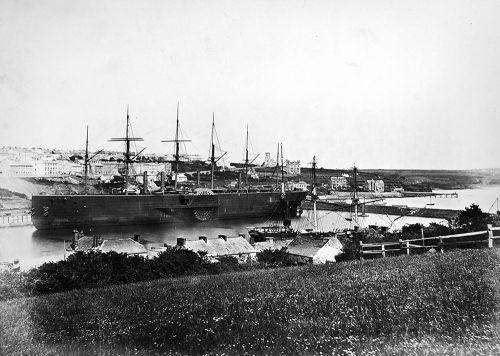
Photograph of the Great Eastern
Milford Haven, circa 1870
Exhibition print (Archives, Wales)
This liner, a veritable « Leviathan of the seas », built by engineer Isambard Kingdom Brunel and commissioned in 1860, was at the time the largest ship ever built. Measuring 211 metres long and 25 metres wide, with 4,000-passenger capacity, it featured water wheels and two powerful steam machines., This motor was indeed the main attraction of the voyage.
The Great Eastern was designed to be a commercial ship, but since it was too large, not suited to the loading or unloading of freight in most ports, difficult to steer and vulnerable to storms, its commercial use was a failure. In 1864, the engineer Cyrus West Field was charged with making alterations to convert the ship into a cable ship. It was then chartered to install transatlantic cables between Ireland and the US coast, a mission that it completed successfully, before being condemned for demolition 31 years after its launch.

Jean-Marc Deschamps
The Great Eastern
Model inspired by the novel The Floating Island, 2004
MJV G179 (Purchased from the artist, 2008)

Jules Verne
The Floating City
Hetzel publishing house, Paris, 1872
MJV A350
In 1867, Jules and Paul Verne crossed the Atlantic between Liverpool and New York. on board the Great Eastern The author recounts this adventure in his log book used as inspiration for the novel The Floating City published in 1871.

Arthur Mangin
Science with the family
The Great Eastern and the transatlantic cable
Musée des Familles magazine, Paris, 1865-1866
MJV A623
Transformed by engineer Cyrus West Field, the liner was used to install a telegraph cable between Ireland and Newfoundland from 1865 to 1866. Its gigantic proportions enabled 4,000 metric tons of cables, over 5,790 kilometres, to be loaded.
