
Portrait of Jules Verne
Oil on canvas, circa 1875
MJV C530
Jules Verne, around 45 years of age, is shown at the peak of his powers, at the time when Around the World in 80 days was a triumph on stage, after its huge success as a book, and when The Mysterious Island was published. It’s an opportunity to admire the reddish-blond tints in his hair and beard, since posterity safeguarded them as white.

Chair belonging to Jules Verne
From the furnishings in the dining room at no. 2 rue Charles-Dubois in Amiens.
MJV G167
Meal time was an important moment for Jules Verne.
Since his younger days in Paris, he had suffered from food-related problems and acute and chronic stomach pains. As he matured and achieved a comfortable life, he developed a need to eat to excess, suffering from a form of bulimia. No doubt a symptom of the diabetes that took his life on March 24, 1905.
Food was such an important concern in the writer’s life that it his work is rife with allusions to food, from hunger pangs to the convivial pleasures of mealtimes.
Due to his deteriorating health, as he got older, Jules Verne followed a strict diet. According to his grandson, Jean Jules Verne (1892-1980), it was at this time that he adopted this short chair on legs. « To complete the formality of mealtimes as quickly as possible, he used a low chair that placed his plate almost at the level of his mouth! »

Busts of Jules Verne
Fabio Stecchi
Terracotta, 1882
MJV G317
Albert Roze, according to Fabio Stecchi
Marble, 1906
MJV G244
The marble bust of Jules Verne by Albert Roze was not created during the author’s lifetime. It dates from 1906 and carried the inscription « Albert Roze d’après Stecchi » (Albert Roze according to Stecchi). Albert Roze was inspired by a work by sculptor Fabio Stecchi: this terracotta bust of Jules Verne made from life in 1883 and presented the same year at the Salon des Artistes Français in Paris. The sculptures by Fabio Stecchi and Albert Roze represent a portrait of Jules Verne cut off at the shoulders, the head at a three-quarter turn, the chin slightly raised; dignified and elegant. In 1883, Fabio Stecchi captured the likeness of a man then aged 55, at the peak of his glory. It is the same solemnity that Albery Roze conveys in this marble bust, as in the one he sculpted soon after for a monument to commemorate the glory of Jules Verne in Amiens.

Champagne glasses
Plates monogrammed with « JV »
Fruit plates monogrammed with « JV »
Coffee cups and saucers
Liqueur service
Silverware
At no. 2 rue Charles-Dubois, in Amiens, the table is laid. Jules Verne left his work quarters on the upper floor of the house to go to the dining room on the ground floor only at mealtimes, to satisfy his voracious appetite. « Did he not eat six enormous artichokes from the floating gardens of Amiens every evening for years? » reported his grandson. Jean Jules-Verne (1892-1980). Jules Verne ate more out of necessity than love of food.
The dishes prepared by his wife Honorine Verne, known to be an excellent cook, wowed the guests, particularly from Amiens, that she liked to invite. When Jules Verne’s gluttony didn’t ruin all her efforts… « I’ve heard extraordinary stories about a leg of lamb devoured while waiting for late guests, and a roast which he gobbled up in its entirety! »
Jules Verne no doubt preferred the company of the journalists he met in his home to these worldly guests. They included Adolphe Brisson, Marie Belloc, Edmondo de Amicis, Robert Sherard,… They came from France, England, Germany and America to talk with the now-famous author of Voyages Extraordinaires, then aged around sixty.
Experience moments of Jules Verne’s private life, of which perhaps the plates, champagne glasses and coffee cups capture memories engraved into the glass and the china.
In the drawers
Throughout his life, Jules Verne remained very close to his parents, brother and sisters. In a spontaneous, sometimes bantering style, the letters he sent them bear witness to his aptitude for writing, first career opportunities, progress of his literary projects, which he shared happily with his family, and the more personal aspects of his life.
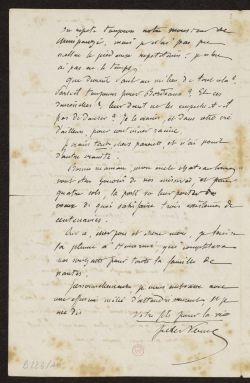
Handwritten letter from Jules and Honorine Verne to his parents, Pierre and Sophie Verne, dated 1January 1858, [Paris]
MJV B226.11 (acquired in 2021 with the support of the Regional Fund for Library Acquisitions (FRAB), Pays de la Loire)
In this New Year greeting letter, co-written by the young Verne couple, the author acknowledges his turbulent life. He is torn between the need to provide for his household by working as a stockbroker at the Banque Eggly, and his yearning to become a playwright and produce operettas at Parisian theatres.
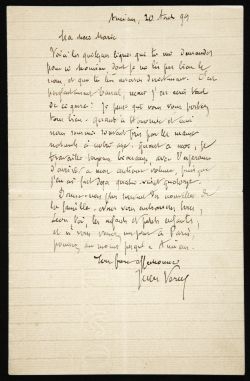
Handwritten letter from Jules Verne to his sister Marie, dated 20 August 1899, Amiens
MJV B305 (donated by the François Guillon-Verne family, 2020)
In this letter to his sister Marie, Jules Verne, then 71 years old, acknowledges that he “still works a lot”, and shares his wish to continue writing until he has completed 100 volumes.
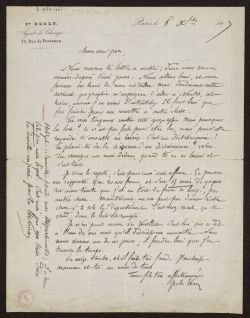
Handwritten letter from Jules Verne to his father, Pierre Verne, dated 5 December 1867, Paris
MJV B272.48 (donated by the Maxime Guillon-Verne family, 2011)
In this letter with the letterhead of his employer, Banque Eggly, Jules Verne defends his decision to accept his publisher Hezel’s request to compile a dictionary in collaboration with Théophile Lavallée:The Illustrated Geography of France and its Colonies. A gruelling but lucrative task.
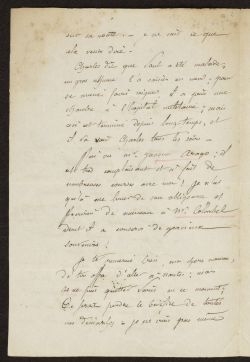
Handwritten letter from Jules Verne to his mother, Sophie Verne, dated 13 May [1851], Paris
MJV B272.12 (donated by the Maxime Guillon-Verne family, 2011)
Jules Verne had scarcely arrived in Paris when he set about developing a network in the literary and theatrical worlds.
In this letter, he writes that he is working for the Odéon and the Opéra-Comique. He also tells of his meeting with Jacques Arago, author of A Voyage Round the World, brought about thanks to the recommendation of Évariste Colombel, who was Mayor of Nantes at the time. A decisive influence for the future author of Extraordinary Voyages.

The Masquerade Ball Held by Mr Jules Verne
Drawings by Mr Vierge according to the sketch by Mr Materre
Le Monde Illustré, April 14, 1877
MJV C116
In Amiens, on April 2, 1877, Jules Verne and his wife Honorine held a masquerade ball: « On Easter Monday, we are throwing a masquerade ball, with 700 invitations sent, 350 accepted at least. The whole town is talking about it ». The reception took place in the salons Saint-Denis, magnificently decorated for the occasion. Many guests took their inspiration for their costumes from the characters from Voyages Extraordinaires.

Gédéon Basil
Grrrrreat Around-The-World Inn
Poster, Amiens, 1885
Exhibition print (Amiens city library)
On March 8, 1885, Jules Verne appeared in cook’s livery to welcome his guests to the masked ball held at his Amiens home. The theme chosen: travel! For the occasion, the house at no. 2 rue Charles Dubois was transformed into a « grande auberge du tour du monde » (a great « around the world » inn) Jules and Honorine dressed as innkeepers while their guests wore traditional costumes from different countries around the world.
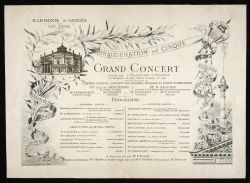
Programme for the Cirque d’Amiens’ inaugural evening. Grand concert performed by the Harmonie d’Amiens 23 June 1889
MJV I107 – Exhibition print
Speech by Jules Verne, Too Many Flowers!Horticultural Society of Picardy newsletter
MJV H790
Jules Verne integrated resolutely into Amiens’ community life, as municipal councillor and member of the Amiens Academy, the Industrial Society, the Horticultural Society and the Esperanto Society, as well as administrator of the Caisse d’Épargne.
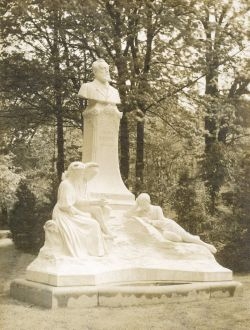
Photograph of the Jules Verne monument, Amiens
Herbert, Amiens, 1909
MJV E8
Jules Verne’s funerary monument, Amiens
Amiens, early 20th century
MJV E22
The sculptor Albert Roze was the Director of Amiens’ School of Fine Arts from 1893 to 1911. Although he rubbed shoulders with him, he did not create any sculptures of the author during his lifetime. In 1906, he drew inspiration from Fabio Stecchi’s terracotta bust to create a marble bust (both are exhibited), which served as a basis for the creation of these two monuments.
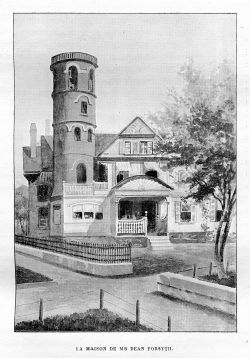
Photograph of the Maison à la Tour
MJV E453 – Exhibition print
Illustration from Jules Verne’s novel
The Chase of the Golden Meteor, 1908
MJV A388 – Exhibition print
Jules and Honorine Verne lived in a house at 2 Rue Charles Dubois in Amiens for 18 years (1882 to 1900). It was in this spacious urban mansion that the author wrote over 30 novels in the Extraordinary Voyages series. He also drew inspiration from the building for two of his works: The Secret of Wilhelm Storitz and The Chase of the Golden Meteor.
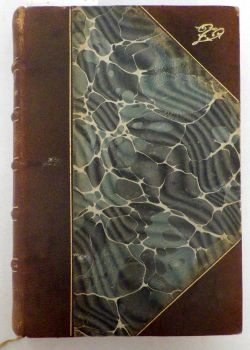
Jules and Michel Verne’s Library, donated to the City of Nantes by Jean Verne (the author’s great-grandson) is composed of over 350 works by French and foreign authors representative of the various literary trends in the 19thand early 20th century.
From Edgar Allan Poe to Victor Hugo and from Charles Dickens to Pierre Loti, Jules Verne read many of his contemporaries’ works, admiring and drawing inspiration from them. Some of the books also contain the author’s handwritten annotations.

Tribute to Jules Verne 2005
Acrylic on canvas
MJV C349
Triptych painted for the World Science Fiction Convention Utopiales (Nantes, November 2005) on the initiative of Gilles Francescano, President of Art & Fact, by Thierry Cardinet, Sandrine Geslin, Didier Graffet, Hubert de Lartigue, Manchu and Pascal Yung, to be gifted to the Jules Verne Museum. Drawing on their own imagination concerning Verne’s world, its authors demonstrate the unimpaired strength of inspiration of the Nantes novelist.
